HART to RS485 Modbus Data Converter Benefits Features and Industrial Applications
A plant can have accurate smart instruments in the field and still struggle to use their data. A pressure transmitter may speak HART. A PLC, RTU, or SCADA system may expect Modbus RTU over RS-485. Without a practical bridge between the two, valuable diagnostic and process data stays trapped at the device level.
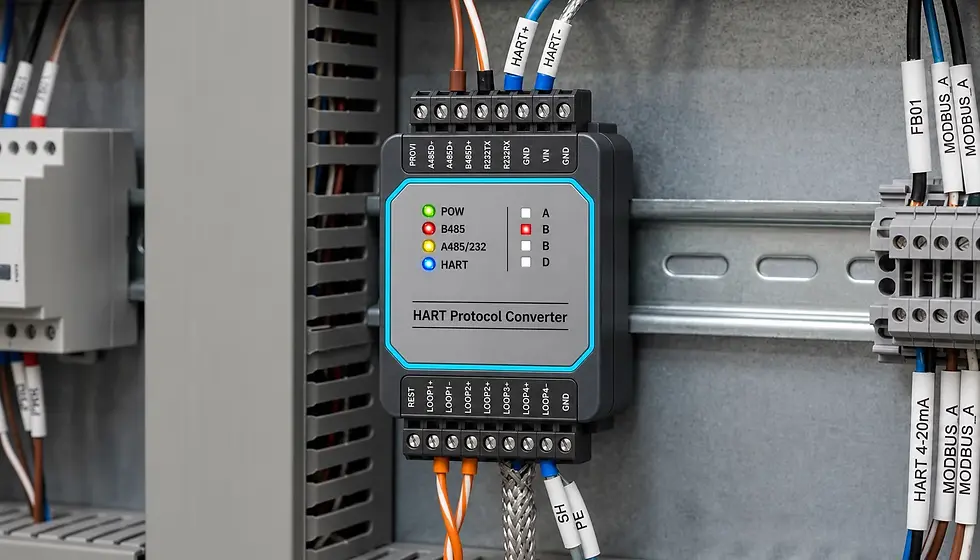
A HART to RS485 Modbus data converter solves that problem. It listens to HART-enabled instruments, reads process variables and device information, then makes that data available as Modbus registers. That simple role can reduce wiring changes, extend the life of installed instruments, and improve monitoring across tanks, skids, treatment systems, pipelines, and production assets.
The result is not just protocol translation. It is a cleaner path from smart instrumentation to control systems, historians, HMIs, and remote monitoring platforms.

How the converter connects HART instruments to Modbus systems
HART and Modbus serve different needs.
HART, short for Highway Addressable Remote Transducer, is commonly used with smart field instruments such as pressure, flow, temperature, and level transmitters. It allows digital communication while the instrument continues to send its traditional 4-20 mA analog signal. In many installations, that analog signal still feeds a controller, while the HART signal carries extra information such as secondary variables, range settings, sensor status, and device diagnostics.
Modbus RTU over RS-485 works differently. It uses a serial network where a Modbus client, often a PLC, RTU, SCADA gateway, or data logger, requests values from connected devices. Those values appear in addresses called registers. Modbus is widely used because it is simple, well understood, and supported by many industrial systems.
A converter sits between these two worlds.
On the HART side, it communicates with one or more HART instruments. Depending on the model and wiring method, it may connect to a single device, a multi-drop HART loop, or multiple input channels. It polls the instruments and collects selected variables.
On the RS-485 side, it behaves like a Modbus RTU device. The host system reads holding registers or input registers from the converter. Each register, or pair of registers, represents a HART value such as:
Primary variable
Secondary, tertiary, or fourth variable
Device status
Loop current
Percent of range
Tag or device identifier
Diagnostic flags
Process units
This register-based approach matters because most PLC and SCADA systems already know how to read Modbus. Instead of adding a special HART interface card or writing custom device drivers, the control system reads familiar Modbus addresses.
The practical value of a protocol converter is that it lets the control system see smart instrument data without replacing the instruments or rebuilding the control network.
A typical data path looks like this:
Stage | What happens | Result |
HART transmitter | Measures the process and sends analog plus digital data | Field data stays available at the instrument |
Converter | Polls HART data and maps it to Modbus registers | HART values become readable by Modbus systems |
RS-485 network | Carries Modbus RTU messages over twisted-pair cable | Data reaches PLCs, RTUs, gateways, or HMIs |
Host system | Reads registers and displays or logs values | Operators and systems can monitor the asset |
This makes the converter useful in both new installations and retrofit projects. It can preserve existing HART devices while connecting them to broader plant data systems.
Key features that matter in real installations
Converter specifications vary, but several features have direct impact on uptime, maintenance, and data quality.
Support for common HART variables
A useful converter should do more than read the primary variable. Many smart instruments provide several values through HART. For example, a multivariable flow transmitter may report differential pressure, static pressure, temperature, and calculated flow. A radar level transmitter may provide level, distance, signal strength, and status.
Access to these values can reduce the need for extra sensors. It also gives maintenance teams more context when something drifts or fails.
Flexible Modbus register mapping
The register map is the contract between the converter and the host system. Clear mapping makes integration easier. Good converters provide documentation that shows each register address, data type, scaling method, and byte order.
Look for support for common data formats, such as:
16-bit integers
32-bit floating point values
Status words
Scaled engineering values
Byte order also matters. Different systems may expect high word first or low word first for floating point data. If the converter allows byte and word order settings, commissioning becomes much easier.
Multi-device polling
Some applications need data from one transmitter. Others may need readings from several instruments on a HART multi-drop loop or multiple loops. A converter that can poll several HART addresses can reduce hardware count and panel space.
Polling speed should match the process. HART is not designed for high-speed control. It is well suited for monitoring, diagnostics, and slower process variables. For fast control loops, the 4-20 mA signal usually remains the main control signal, while HART data supports monitoring and maintenance.
Electrical isolation and noise resistance
Industrial sites often include long cable runs, motors, variable frequency drives, pumps, and grounding differences between equipment. Isolation helps protect communication ports and reduce problems caused by ground potential differences.
For RS-485 networks, biasing, termination, and shielding practices matter. A converter designed for industrial environments should support stable serial communication, clear status indication, and suitable operating temperature ranges for the enclosure where it will be mounted.
Useful diagnostics
LEDs and diagnostic registers can save time during startup and troubleshooting. At minimum, status indicators should show power, HART activity, and Modbus activity. More advanced units may provide communication error counters, device timeout flags, or HART command status.
These details reduce guesswork. If the host system is not receiving data, maintenance staff can quickly tell whether the issue is on the HART side, the RS-485 side, or the Modbus register configuration.
Installation tips for dependable communication
A converter is not difficult to install, but communication reliability depends on the details. Treat installation as both an electrical task and a data mapping task.
Confirm loop wiring and HART signal conditions
HART uses a digital signal superimposed on the 4-20 mA loop. The loop must meet the instrument and network requirements for HART communication. In many cases, a proper loop resistance is needed for the HART signal to be detected.
Before connecting the converter, verify:
The transmitter is HART-capable and enabled
The loop is powered correctly
Polarity is correct
Loop resistance meets the instrument requirements
The HART device address is known
The analog control function is not disturbed
In point-to-point HART loops, the device address is often set to zero. In multi-drop HART networks, each instrument needs a unique polling address.
Plan the RS-485 network before landing wires
RS-485 performs best when wired as a bus, not a star. Use twisted-pair cable, keep stubs short, and place termination at the ends of the network when needed. Match the serial settings across all devices, including baud rate, parity, stop bits, and Modbus address.
Common checks include:
Unique Modbus slave address for each device
Correct A and B polarity
Proper shield grounding practice
Termination at the two physical ends of the bus
Biasing when the network needs defined idle-state voltage
Cable routing away from high-noise power conductors
If communication fails, swapping A and B is a common test, but it should not replace careful documentation.
Build a register list before programming the PLC or SCADA system
Before writing code or configuring screens, list the exact values needed from each instrument. Include register addresses, data types, engineering units, scaling, and alarm meaning. This avoids confusion later when a value appears wrong because of word order or scaling, not because of a bad transmitter.
A simple commissioning worksheet can include:
Item | Example entry |
HART device tag | LT-204 |
HART address | 0 |
Value needed | Primary variable |
Modbus register | 40001 and 40002 |
Data type | 32-bit float |
Unit | Feet |
Update need | Monitoring only |
Alarm use | High level advisory |
Keep this worksheet with the panel drawings or controls documentation. Future maintenance will be much easier.
Test in stages
Do not wait until every cable is landed and every screen is built. Test each part in order.
Power up the converter and verify status LEDs.
Confirm HART communication with one device.
Read a known Modbus register using a test tool or PLC.
Confirm scaling and byte order.
Add the remaining instruments.
Check the final values in the HMI, historian, or monitoring system.
This staged approach helps isolate faults. It also reduces startup time because each issue has a smaller search area.

Industrial applications that gain from HART to Modbus conversion
The value of a converter grows when smart instrument data can support operations, maintenance, and process reporting.
Water and wastewater systems
Water treatment plants, lift stations, and remote tanks often use level, flow, pressure, and analytical transmitters. Many remote sites already rely on RTUs that support Modbus RTU. A converter can bring HART diagnostics and secondary variables into the telemetry system without changing the field instruments.
For example, an RTU can read a tank level transmitter through Modbus while maintenance staff also sees device status. If the transmitter reports a weak echo or sensor warning, the system can flag the issue before the reading becomes unreliable.
Oil, gas, and pipeline monitoring
Pipeline and production sites often combine older analog loops with newer remote monitoring systems. HART data can help operators see more than a single process value. Pressure, temperature, valve position, flow calculations, and diagnostic states can feed RTUs over RS-485.
This is useful at remote assets where site visits are costly. Better visibility can help teams decide whether an alarm needs immediate action or scheduled maintenance.
Chemical and batch processing
Batch systems often need traceable process data. Smart transmitters can provide extra variables and device health data that support quality checks and maintenance records. A converter allows this data to enter a Modbus-based PLC or historian.
The analog signal can still serve a control loop, while the digital HART values support monitoring and reporting. That split can reduce risk when retrofitting older processes.
Power generation and utilities
Power plants and utility sites may have distributed equipment where Modbus RTU remains common. Temperature, pressure, vibration-related measurements, and level transmitters can feed central monitoring through RS-485 networks.
In these environments, diagnostic data can help maintenance teams focus attention on devices showing early warning signs rather than relying only on scheduled checks.
OEM skids and packaged systems
Skid builders often need a repeatable way to connect instruments to the customer’s control system. Using HART instruments with a Modbus converter can make the skid easier to integrate, especially when the end user expects a Modbus RTU interface.
For decision-makers, this can reduce custom engineering on each project. For controls teams, it gives a predictable register map and a cleaner handoff.
Advantages for data acquisition and monitoring
A HART to RS485 Modbus converter can improve data acquisition without forcing a full system replacement. That is often its strongest business case.
It protects existing instrument investments
Many industrial sites already have HART-enabled transmitters installed. Replacing them just to get digital data can be costly and disruptive. A converter lets the site use data that the instruments already produce.
This is especially helpful during phased modernization projects. Teams can add monitoring first, then upgrade controllers or networks later.
It reduces integration complexity
Modbus RTU is one of the most widely supported industrial protocols. PLCs, RTUs, gateways, HMIs, data loggers, and SCADA systems often include Modbus drivers as standard features.
By presenting HART data as Modbus registers, the converter avoids special drivers in many cases. This makes integration easier for small systems and mixed-vendor sites.
It improves visibility into device health
The 4-20 mA signal tells the control system the main process value. HART can tell more of the story. Device status, sensor warnings, range information, and secondary variables help maintenance staff detect problems earlier.
That visibility can support:
Faster troubleshooting
Better calibration planning
Fewer unnecessary site visits
Improved confidence in remote readings
More complete asset records
It supports centralized monitoring
Once HART data appears on a Modbus network, it can flow to historians, dashboards, remote gateways, or alarming systems. The converter becomes a small but important part of the plant data path.
For monitoring projects, this can be a practical middle ground. It avoids the cost of replacing every instrument or adding a full asset management system where only key values are needed.
It separates control needs from monitoring needs
Not every value needs to be part of closed-loop control. Some values are needed only for trending, maintenance, reporting, or operator awareness.
The analog signal can continue serving fast control needs. The converter can supply slower digital data for monitoring. This separation keeps critical control simple while expanding data access.

What to review before selecting a converter
The right converter depends on the site architecture and the data required. Before choosing a model, review these points with controls, instrumentation, and operations teams.
Number of HART devices
Confirm whether the application needs one channel, several isolated channels, or multi-drop polling.
Required values
List every process variable, diagnostic flag, and status word the host system needs to read.
Host system compatibility
Check Modbus RTU settings, register addressing style, supported data types, and floating point byte order.
Update rate
Match polling speed to the process. HART is well suited for monitoring and diagnostics, not high-speed motion or safety-critical control.
Power and enclosure needs
Confirm supply voltage, mounting method, temperature rating, and space inside the panel.
Documentation quality
A clear manual, complete register map, and readable wiring diagrams can save hours during commissioning.
Isolation and environmental rating
For long runs, noisy sites, or remote assets, isolation and surge protection practices become more important.
The practical takeaway
A HART to RS485 Modbus data converter is a focused device with a valuable job. It connects smart HART instruments to Modbus systems, turns field data into readable registers, and helps plants use information that may already exist in their transmitters.
For engineers, it offers a direct path to integrate HART variables, status, and diagnostics into PLCs, RTUs, and SCADA systems. For decision-makers, it can extend asset life, reduce retrofit cost, and improve monitoring without a major controls rebuild.
The best results come from choosing the right converter, planning the register map early, wiring the RS-485 network correctly, and testing each communication layer before startup. Done well, the converter becomes a reliable bridge between field intelligence and plant-level visibility.

Comments